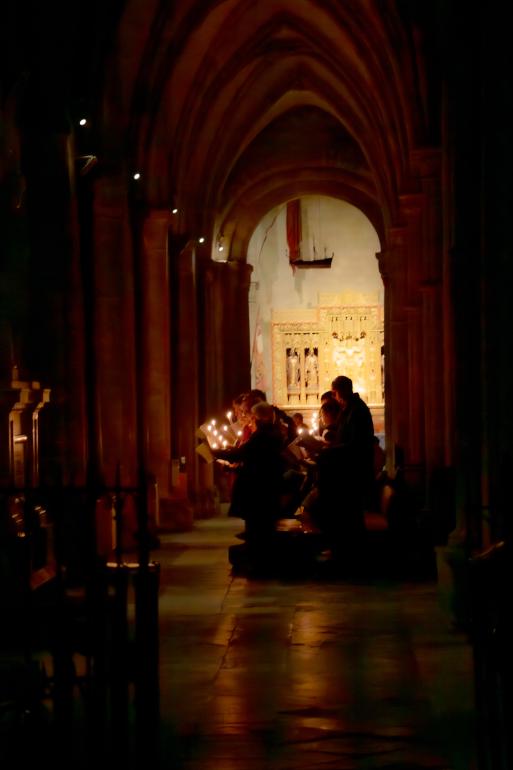
As Advent begins, the Cathedral becomes a place of quiet anticipation and light. This season invites us to pause, reflect, and prepare for the mystery of Christmas.
In our new blog series, our Dean and residentiary canons share their own thoughts on what these weeks mean to them - moments of hope, music, and meaning that shape the life of the Cathedral.
Here, our Canon Chancellor, the Revd Dr Earl Collins, reflects on the significance of Advent, the hymns that carry its message, and the symbolism of light.
‘Come thou long expected Jesus’
Charles Wesley
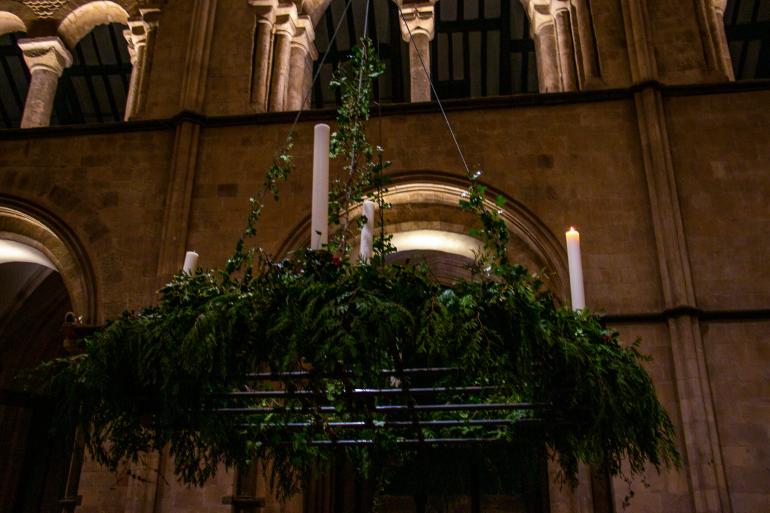
This great season of Advent, with its characteristic wreath, purple robes, special hymns and readings (especially from the prophet Isaiah), is one of the richest in the Church’s year. As we move further into the darkness of winter (at least in the northern hemisphere), we celebrate the various comings of Christ. Indeed, the word Advent means ‘coming’ and ‘arrival’. The Church speaks of his three comings:
- His first coming in humility as a child in Bethlehem (Matthew 2.1).
- His final and glorious coming to judge the living and the dead (1 Timothy 6.14).
- His coming to us at every moment of our lives, in word and sacrament, in the mystery of worship, in prayer – and as he said he would – his coming in the bodies of the poor and suffering (Matthew 25. 31-46).
The importance of Advent
Advent is also one of the most beautiful seasons of the Christian Year. The ancient wisdom of the Church’s worship shows us why it really matters. It is a journey of faith. With its onward movement through four weeks, it teaches us about patience in waiting, a virtue that may sometimes get lost in our frenetic world. Advent shows us that ‘the long-expected Jesus’ - God’s promised Messiah - did not just appear out of the blue. Rather, for centuries God prepared the world for Christ’s coming, sending prophets to his people Israel to make them ready. Finally, he sent the towering figure of John the Baptist, to make Christ known to all when at last he came. By observing Advent, we learn how important the rhythms of life are: watching and waiting, patient expectation, and anticipated joy.
Advent’s four Sundays
Each of this season’s four weeks offers something special to celebrate the different comings of Christ, beginning with the cathedral’s great Advent procession, symbolising the entry of God’s light into our darkness. ‘I look from afar,’ we sing, gazing into the dark and asking John the Baptist’s question, ‘Are you the one who is to come?’ ‘Are you really the long-expected one?’
- On the first Sunday, Christ’s final coming is set before us. It is a call for accountability, a stark reminder that God will ask us how we have treated one another and our planet. Yet when Christ finally comes, he will judge us all with mercy and compassion.
- The second Sunday confronts us with the towering figure of John the Baptist in the wilderness, preaching conversion and suffering persecution for his prophetic witness.
- The third Sunday shows how John was imprisoned and how Christ our Lord praised him as the greatest of the prophets.
- Only on the fourth and final Sunday, as we approach Christmas itself, do we hear the story of Jesus’ miraculous conception and look forward to his birth, with Mary his mother and Joseph his foster father central to the narrative.
What it all means
This child, we are told, will be called ‘Emmanuel’ a name which means ‘God is with us.’ In one of our Christmas carols we will sing to Jesus, ‘The hopes and fears of all the years are met in thee tonight’. In Christ, the long-expected Jesus, God’s Word-made-flesh, all God’s promises were kept and human hopes and expectations fulfilled beyond imagining.
The Advent hymns
During this season cathedral choirs sing particularly beautiful hymns, both ancient and modern. ‘Come Thou Long-Expected Jesus’ written by the great 18th century Anglican hymnwriter and priest Charles Wesley, captures well the notes of yearning and expectation so characteristic of Advent and how God prepared his chosen people for the coming of the Messiah:
Israel's strength and consolation,
hope of all the earth thou art:
dear desire of every nation,
joy of every longing heart.
But it is ‘O Come, O Come Emmanuel’, translated by another Anglican priest, John Mason Neale, and perhaps the best-known Advent hymn, that best directs our gaze upwards and outwards to the one who is to come. Based on a series of beautiful medieval chants, it invokes Jesus the Messiah as light and wisdom, the nations’ desire and our Saviour, calling us to rejoice at the salvation that he brings:
Rejoice! Rejoice!
Emmanuel shall come to thee, O Israel.
Trusting in the Light
Advent teaches us that God comes to meet us in our deepest desire for love. We are never alone, no matter how dark things become or how dark we may make them: as we will hear at Christmas, ‘God is with us.’ Advent prepares us to celebrate that. We learn to trust in God, to trust in his light, to open our hearts to him.
Between his first coming at Christmas and his final coming at the end of time, Christ comes to us every day, at every moment, in prayer and worship and in the needs of our neighbour.
Advent is God’s call to us: waken up and see, for the long-awaited Saviour, the long-expected Jesus, has come – is coming daily - and will come again in glory!